
Batch Convert DOCX to PDF: Enterprise Solutions & Automation Guide 2025
Complete guide to batch DOCX to PDF conversion for enterprises. Compare tools, automation methods, and scalable solutions for large-volume document processing.
DocxToPDF Team
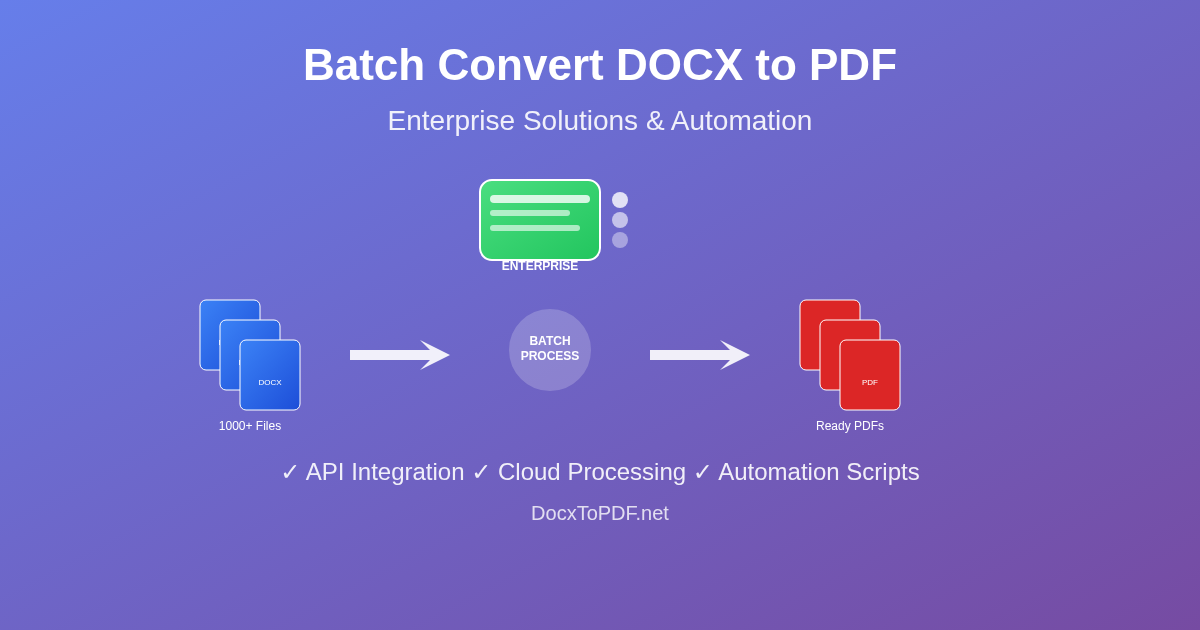
Batch Convert DOCX to PDF: Enterprise Solutions & Automation Guide 2025
In today's enterprise environment, manually converting individual DOCX files to PDF is inefficient and time-consuming. Organizations often deal with hundreds or thousands of documents that require conversion for distribution, archiving, or compliance purposes. This comprehensive guide explores enterprise-grade batch conversion solutions, automation strategies, and scalable approaches to handle high-volume DOCX to PDF processing efficiently.
Understanding Enterprise Conversion Needs
Common Enterprise Scenarios
High-Volume Processing Requirements:
- Monthly reports - Converting 100+ departmental reports
- Policy updates - Batch converting updated documents across organizations
- Archive migration - Converting legacy DOCX files to PDF for long-term storage
- Compliance documentation - Processing regulatory submissions
- Client deliverables - Converting project documents for external distribution
Key Enterprise Challenges
Volume and Scale Issues
- Processing thousands of files simultaneously
- Peak load management during reporting periods
- Storage optimization for large file collections
- Network bandwidth considerations for cloud processing
- Time constraints for urgent document deliveries
Quality and Consistency Requirements
- Formatting preservation across diverse document types
- Brand consistency with standardized layouts
- Error handling for problematic documents
- Quality assurance processes for converted outputs
- Metadata preservation and management
Security and Compliance Considerations
- Data protection during conversion processes
- Access control for sensitive documents
- Audit trails for compliance reporting
- Encryption requirements for confidential files
- Regulatory compliance (GDPR, HIPAA, SOX)
Enterprise Batch Conversion Solutions
1. Professional Desktop Software
Adobe Acrobat Pro DC (Enterprise)
Key Features:
- Batch processing up to 1000+ files
- Watched folder automation
- Custom preflight profiles for quality control
- OCR capabilities for scanned documents
- Digital signature batch application
Enterprise Benefits:
- Volume licensing available
- IT deployment tools and policies
- Integration with Adobe Creative Cloud
- Advanced security features
- Professional support and training
Pricing: $239.88/year per user (Adobe Creative Cloud for teams)
Setup Example:
// Adobe Acrobat Batch Processing Setup 1. Tools → Batch Processing → New Sequence 2. Select "Convert to PDF" action 3. Configure input folder: /documents/docx/ 4. Set output folder: /documents/pdf/ 5. Schedule: Daily at 2:00 AM 6. Enable error logging and notificationsjavascript
Foxit PhantomPDF Business
Key Features:
- Mass conversion capabilities
- Command-line interface for automation
- SharePoint integration
- Custom branding and watermarking
- Compliance features (PDF/A, PDF/UA)
Enterprise Advantages:
- Lower cost than Adobe solutions
- Flexible licensing options
- API integration capabilities
- Cloud and on-premise deployment
- Bulk user management
Pricing: $159/year per user
2. Server-Based Solutions
Microsoft SharePoint with Power Automate
Automated Workflow Setup:
Trigger: New DOCX file added to SharePoint library Actions: 1. Detect file type (DOCX validation) 2. Convert to PDF using Office Online 3. Save to designated PDF library 4. Send notification to stakeholders 5. Archive original DOCX fileyaml
Benefits:
- Native Microsoft integration
- Scalable cloud processing
- No additional software licensing
- Built-in approval workflows
- Integration with Microsoft 365
Google Workspace with Apps Script
Automation Script Example:
function batchConvertDocxToPdf() { const sourceFolder = DriveApp.getFolderById('SOURCE_FOLDER_ID'); const targetFolder = DriveApp.getFolderById('TARGET_FOLDER_ID'); const docxFiles = sourceFolder.getFilesByType(MimeType.MICROSOFT_WORD); while (docxFiles.hasNext()) { const file = docxFiles.next(); const blob = file.getBlob(); const pdfBlob = blob.getAs(MimeType.PDF); targetFolder.createFile(pdfBlob); Logger.log(`Converted: ${file.getName()}`); } }javascript
3. Cloud-Based Enterprise Solutions
AWS Document Processing Pipeline
Architecture Components:
- S3 buckets for file storage
- Lambda functions for conversion processing
- SQS queues for job management
- CloudWatch for monitoring and logging
- IAM roles for security management
Implementation Example:
import boto3 import json def lambda_handler(event, context): # Process S3 upload event s3_client = boto3.client('s3') textract_client = boto3.client('textract') bucket = event['Records'][0]['s3']['bucket']['name'] key = event['Records'][0]['s3']['object']['key'] # Convert DOCX to PDF using Textract response = textract_client.start_document_analysis( DocumentLocation={ 'S3Object': { 'Bucket': bucket, 'Name': key } }, FeatureTypes=['TABLES', 'FORMS'] ) return { 'statusCode': 200, 'body': json.dumps('Conversion initiated') }python
Enterprise Benefits:
- Unlimited scalability
- Pay-per-use pricing model
- Global availability
- Integrated security features
- Monitoring and analytics
4. API-Based Solutions
DocxToPDF.net Enterprise API
Features:
- RESTful API for easy integration
- Batch endpoints for multiple files
- Webhook notifications for completion status
- Custom branding options
- Priority processing for urgent conversions
API Usage Example:
import requests import json def batch_convert_docx_to_pdf(file_list): api_endpoint = "https://api.docxtopdf.net/v1/batch-convert" headers = { 'Authorization': 'Bearer YOUR_API_KEY', 'Content-Type': 'application/json' } payload = { 'files': file_list, 'options': { 'quality': 'high', 'format': 'pdf', 'notification_webhook': 'https://your-domain.com/webhook' } } response = requests.post(api_endpoint, headers=headers, data=json.dumps(payload)) return response.json() # Example usage files_to_convert = [ {'url': 'https://storage.com/doc1.docx', 'name': 'report1.pdf'}, {'url': 'https://storage.com/doc2.docx', 'name': 'report2.pdf'} ] result = batch_convert_docx_to_pdf(files_to_convert) print(f"Batch job ID: {result['job_id']}")python
Command-Line and Scripting Solutions
1. LibreOffice Headless Conversion
Installation and Setup:
# Ubuntu/Debian installation sudo apt-get update sudo apt-get install libreoffice # CentOS/RHEL installation sudo yum install libreoffice-headlessbash
Batch Conversion Script:
#!/bin/bash # batch_convert.sh - Convert all DOCX files in a directory INPUT_DIR="/path/to/docx/files" OUTPUT_DIR="/path/to/pdf/output" LOG_FILE="/var/log/docx_conversion.log" # Create output directory if it doesn't exist mkdir -p "$OUTPUT_DIR" # Function to convert single file convert_file() { local input_file="$1" local filename=$(basename "$input_file" .docx) local output_file="$OUTPUT_DIR/${filename}.pdf" echo "Converting: $input_file" >> "$LOG_FILE" libreoffice --headless \ --convert-to pdf \ --outdir "$OUTPUT_DIR" \ "$input_file" 2>&1 >> "$LOG_FILE" if [ $? -eq 0 ]; then echo "Success: $output_file" >> "$LOG_FILE" else echo "Error converting: $input_file" >> "$LOG_FILE" fi } # Process all DOCX files find "$INPUT_DIR" -name "*.docx" -type f | while read file; do convert_file "$file" done echo "Batch conversion completed. Check $LOG_FILE for details."bash
Advanced Parallel Processing:
#!/bin/bash # parallel_convert.sh - Process files in parallel INPUT_DIR="/path/to/docx/files" OUTPUT_DIR="/path/to/pdf/output" MAX_PARALLEL=4 # Function for parallel conversion convert_parallel() { local input_file="$1" local filename=$(basename "$input_file" .docx) libreoffice --headless \ --convert-to pdf \ --outdir "$OUTPUT_DIR" \ "$input_file" } export -f convert_parallel export OUTPUT_DIR # Use GNU parallel for concurrent processing find "$INPUT_DIR" -name "*.docx" -type f | \ parallel -j "$MAX_PARALLEL" convert_parallel {} echo "Parallel conversion completed."bash
2. PowerShell Enterprise Script
Windows Enterprise Solution:
# BatchDocxToPdf.ps1 param( [Parameter(Mandatory=$true)] [string]$InputDirectory, [Parameter(Mandatory=$true)] [string]$OutputDirectory, [int]$MaxConcurrentJobs = 5 ) # Function to convert single document function Convert-DocxToPdf { param( [string]$InputFile, [string]$OutputDir ) try { # Create Word Application object $Word = New-Object -ComObject Word.Application $Word.Visible = $false $Word.DisplayAlerts = 0 # Open document $Doc = $Word.Documents.Open($InputFile) # Generate output filename $FileName = [System.IO.Path]::GetFileNameWithoutExtension($InputFile) $OutputFile = Join-Path $OutputDir "$FileName.pdf" # Export as PDF $Doc.ExportAsFixedFormat($OutputFile, 17) # 17 = PDF format # Cleanup $Doc.Close() $Word.Quit() Write-Output "Converted: $InputFile -> $OutputFile" } catch { Write-Error "Failed to convert $InputFile : $($_.Exception.Message)" } finally { # Ensure Word is properly closed if ($Word) { [System.Runtime.Interopservices.Marshal]::ReleaseComObject($Word) | Out-Null } } } # Create output directory if it doesn't exist if (!(Test-Path $OutputDirectory)) { New-Item -ItemType Directory -Path $OutputDirectory -Force } # Get all DOCX files $DocxFiles = Get-ChildItem -Path $InputDirectory -Filter "*.docx" -Recurse # Process files with job management $Jobs = @() foreach ($File in $DocxFiles) { # Wait if too many concurrent jobs while ((Get-Job -State Running).Count -ge $MaxConcurrentJobs) { Start-Sleep -Seconds 1 } # Start new conversion job $Job = Start-Job -ScriptBlock { param($InputFile, $OutputDir, $ConvertFunction) & $ConvertFunction -InputFile $InputFile -OutputDir $OutputDir } -ArgumentList $File.FullName, $OutputDirectory, ${function:Convert-DocxToPdf} $Jobs += $Job } # Wait for all jobs to complete $Jobs | Wait-Job # Get results and cleanup $Jobs | Receive-Job $Jobs | Remove-Job Write-Output "Batch conversion completed. Processed $($DocxFiles.Count) files."powershell
3. Python Enterprise Solution
Comprehensive Python Script:
#!/usr/bin/env python3 """ Enterprise DOCX to PDF Batch Converter Features: Parallel processing, error handling, logging, progress tracking """ import os import sys import json import logging import argparse from pathlib import Path from concurrent.futures import ThreadPoolExecutor, as_completed from typing import List, Dict, Optional import subprocess import shutil from datetime import datetime class DocxToPdfConverter: def __init__(self, input_dir: str, output_dir: str, max_workers: int = 4, log_level: str = 'INFO'): self.input_dir = Path(input_dir) self.output_dir = Path(output_dir) self.max_workers = max_workers # Setup logging logging.basicConfig( level=getattr(logging, log_level), format='%(asctime)s - %(levelname)s - %(message)s', handlers=[ logging.FileHandler('docx_conversion.log'), logging.StreamHandler(sys.stdout) ] ) self.logger = logging.getLogger(__name__) # Create output directory self.output_dir.mkdir(parents=True, exist_ok=True) # Conversion statistics self.stats = { 'total': 0, 'successful': 0, 'failed': 0, 'errors': [] } def find_docx_files(self) -> List[Path]: """Find all DOCX files in input directory""" docx_files = list(self.input_dir.rglob('*.docx')) # Filter out temporary files docx_files = [f for f in docx_files if not f.name.startswith('~$')] return docx_files def convert_single_file(self, input_file: Path) -> Dict[str, any]: """Convert single DOCX file to PDF""" try: # Generate output filename relative_path = input_file.relative_to(self.input_dir) output_file = self.output_dir / relative_path.with_suffix('.pdf') output_file.parent.mkdir(parents=True, exist_ok=True) # LibreOffice conversion command cmd = [ 'libreoffice', '--headless', '--convert-to', 'pdf', '--outdir', str(output_file.parent), str(input_file) ] # Execute conversion result = subprocess.run( cmd, capture_output=True, text=True, timeout=120 # 2 minute timeout per file ) if result.returncode == 0: self.logger.info(f"Converted: {input_file.name}") return { 'status': 'success', 'input_file': str(input_file), 'output_file': str(output_file), 'message': 'Conversion successful' } else: error_msg = result.stderr or result.stdout or 'Unknown error' self.logger.error(f"Failed to convert {input_file.name}: {error_msg}") return { 'status': 'failed', 'input_file': str(input_file), 'error': error_msg } except subprocess.TimeoutExpired: error_msg = f"Conversion timeout for {input_file.name}" self.logger.error(error_msg) return { 'status': 'failed', 'input_file': str(input_file), 'error': error_msg } except Exception as e: error_msg = f"Unexpected error converting {input_file.name}: {str(e)}" self.logger.error(error_msg) return { 'status': 'failed', 'input_file': str(input_file), 'error': error_msg } def batch_convert(self) -> Dict[str, any]: """Execute batch conversion with parallel processing""" docx_files = self.find_docx_files() self.stats['total'] = len(docx_files) if not docx_files: self.logger.warning("No DOCX files found in input directory") return self.stats self.logger.info(f"Found {len(docx_files)} DOCX files to convert") # Process files in parallel with ThreadPoolExecutor(max_workers=self.max_workers) as executor: # Submit all jobs future_to_file = { executor.submit(self.convert_single_file, file): file for file in docx_files } # Process completed jobs for future in as_completed(future_to_file): result = future.result() if result['status'] == 'success': self.stats['successful'] += 1 else: self.stats['failed'] += 1 self.stats['errors'].append(result) return self.stats def generate_report(self) -> str: """Generate conversion report""" report = { 'conversion_date': datetime.now().isoformat(), 'input_directory': str(self.input_dir), 'output_directory': str(self.output_dir), 'statistics': self.stats, 'success_rate': (self.stats['successful'] / max(1, self.stats['total'])) * 100 } report_file = self.output_dir / 'conversion_report.json' with open(report_file, 'w') as f: json.dump(report, f, indent=2) return str(report_file) def main(): parser = argparse.ArgumentParser(description='Enterprise DOCX to PDF Batch Converter') parser.add_argument('input_dir', help='Input directory containing DOCX files') parser.add_argument('output_dir', help='Output directory for PDF files') parser.add_argument('--workers', type=int, default=4, help='Number of parallel workers (default: 4)') parser.add_argument('--log-level', choices=['DEBUG', 'INFO', 'WARNING', 'ERROR'], default='INFO', help='Logging level (default: INFO)') args = parser.parse_args() # Check if LibreOffice is available if not shutil.which('libreoffice'): print("Error: LibreOffice not found. Please install LibreOffice.") sys.exit(1) # Initialize converter converter = DocxToPdfConverter( input_dir=args.input_dir, output_dir=args.output_dir, max_workers=args.workers, log_level=args.log_level ) # Execute batch conversion print(f"Starting batch conversion...") print(f"Input directory: {args.input_dir}") print(f"Output directory: {args.output_dir}") print(f"Parallel workers: {args.workers}") stats = converter.batch_convert() report_file = converter.generate_report() # Print summary print(f"\nConversion Summary:") print(f"Total files: {stats['total']}") print(f"Successful: {stats['successful']}") print(f"Failed: {stats['failed']}") print(f"Success rate: {(stats['successful'] / max(1, stats['total'])) * 100:.1f}%") print(f"Detailed report saved to: {report_file}") if stats['failed'] > 0: print(f"\nFailed conversions:") for error in stats['errors']: print(f" - {error['input_file']}: {error['error']}") if __name__ == "__main__": main()python
Enterprise Integration Patterns
1. Workflow Integration
SharePoint + Power Automate Integration
Workflow Steps:
- Document upload triggers Power Automate flow
- Validation checks ensure DOCX format and metadata
- Conversion service processes document
- Quality assurance validates output PDF
- Distribution to designated SharePoint libraries
- Notification to stakeholders upon completion
SAP Integration Example
# SAP RFC integration for document processing import pyrfc class SAPDocumentProcessor: def __init__(self, sap_config): self.connection = pyrfc.Connection(**sap_config) def process_documents(self, document_list): """Process documents through SAP workflow""" for doc_info in document_list: # Call SAP function module result = self.connection.call( 'Z_CONVERT_DOC_TO_PDF', DOC_PATH=doc_info['path'], DOC_TYPE='DOCX', OUTPUT_FORMAT='PDF' ) if result['RETURN_CODE'] == 0: print(f"SAP processing successful: {doc_info['name']}") else: print(f"SAP processing failed: {result['MESSAGE']}")python
2. Microservices Architecture
Docker Container Solution
Dockerfile:
FROM ubuntu:20.04 # Install LibreOffice and dependencies RUN apt-get update && apt-get install -y \ libreoffice \ python3 \ python3-pip \ && rm -rf /var/lib/apt/lists/* # Install Python dependencies COPY requirements.txt /app/ RUN pip3 install -r /app/requirements.txt # Copy application COPY . /app/ WORKDIR /app # Expose port EXPOSE 8000 # Start application CMD ["python3", "app.py"]dockerfile
Kubernetes Deployment:
apiVersion: apps/v1 kind: Deployment metadata: name: docx-to-pdf-converter spec: replicas: 3 selector: matchLabels: app: docx-converter template: metadata: labels: app: docx-converter spec: containers: - name: converter image: docx-to-pdf:latest ports: - containerPort: 8000 resources: requests: memory: "512Mi" cpu: "250m" limits: memory: "1Gi" cpu: "500m" volumeMounts: - name: document-storage mountPath: /documents volumes: - name: document-storage persistentVolumeClaim: claimName: document-pvcyaml
Performance Optimization Strategies
1. Resource Management
Memory Optimization
LibreOffice Headless Tuning:
# Optimize LibreOffice for batch processing export LIBREOFFICE_MEMORY_LIMIT=2048 export LIBREOFFICE_CPU_LIMIT=2 # Use custom LibreOffice profile mkdir -p ~/.config/libreoffice/4/user cat > ~/.config/libreoffice/4/user/registrymodifications.xcu << 'EOF' <?xml version="1.0" encoding="UTF-8"?> <oor:items xmlns:oor="http://openoffice.org/2001/registry"> <item oor:path="/org.openoffice.Office.Common/Cache"> <prop oor:name="GraphicManager" oor:op="fuse"> <prop oor:name="TotalCacheSize" oor:type="xs:int"> <value>256000000</value> </prop> </prop> </item> </oor:items> EOFbash
CPU Optimization
Parallel Processing Configuration:
import multiprocessing import psutil class OptimizedConverter: def __init__(self): # Calculate optimal worker count cpu_count = multiprocessing.cpu_count() memory_gb = psutil.virtual_memory().total / (1024**3) # Rule: 1 worker per 2GB RAM, max 75% of CPU cores max_workers = min( int(memory_gb / 2), int(cpu_count * 0.75) ) self.workers = max(1, max_workers) print(f"Optimized for {self.workers} parallel workers")python
2. Quality Assurance Automation
Automated Quality Checks
import PyPDF2 from PIL import Image import fitz # PyMuPDF class PDFQualityChecker: def __init__(self, pdf_path): self.pdf_path = pdf_path self.issues = [] def check_pdf_integrity(self): """Verify PDF file integrity""" try: with open(self.pdf_path, 'rb') as file: pdf_reader = PyPDF2.PdfReader(file) page_count = len(pdf_reader.pages) if page_count == 0: self.issues.append("PDF has no pages") return page_count > 0 except Exception as e: self.issues.append(f"PDF integrity error: {str(e)}") return False def check_text_extraction(self): """Verify text can be extracted""" try: doc = fitz.open(self.pdf_path) total_text = "" for page in doc: total_text += page.get_text() if len(total_text.strip()) == 0: self.issues.append("No extractable text found") return False return True except Exception as e: self.issues.append(f"Text extraction error: {str(e)}") return False def check_image_quality(self): """Verify embedded images""" try: doc = fitz.open(self.pdf_path) image_count = 0 for page_num in range(len(doc)): page = doc[page_num] image_list = page.get_images() image_count += len(image_list) return image_count, True except Exception as e: self.issues.append(f"Image check error: {str(e)}") return 0, False def generate_quality_report(self): """Generate comprehensive quality report""" report = { 'file_path': self.pdf_path, 'timestamp': datetime.now().isoformat(), 'checks': { 'integrity': self.check_pdf_integrity(), 'text_extraction': self.check_text_extraction(), 'images': self.check_image_quality() }, 'issues': self.issues, 'overall_status': len(self.issues) == 0 } return reportpython
Monitoring and Analytics
1. Performance Monitoring
Prometheus Metrics Integration
from prometheus_client import Counter, Histogram, Gauge, start_http_server import time # Define metrics conversion_total = Counter('docx_pdf_conversions_total', 'Total number of conversions', ['status']) conversion_duration = Histogram('docx_pdf_conversion_duration_seconds', 'Time spent on conversions') active_conversions = Gauge('docx_pdf_active_conversions', 'Number of active conversions') queue_size = Gauge('docx_pdf_queue_size', 'Number of files in conversion queue') class MonitoredConverter: def convert_with_metrics(self, input_file): active_conversions.inc() start_time = time.time() try: # Perform conversion result = self.convert_file(input_file) if result['status'] == 'success': conversion_total.labels(status='success').inc() else: conversion_total.labels(status='failed').inc() finally: duration = time.time() - start_time conversion_duration.observe(duration) active_conversions.dec() # Start metrics server start_http_server(8000)python
Dashboard Configuration
Grafana Dashboard JSON:
{ "dashboard": { "title": "DOCX to PDF Conversion Metrics", "panels": [ { "title": "Conversion Rate", "type": "stat", "targets": [ { "expr": "rate(docx_pdf_conversions_total[5m])", "legendFormat": "Conversions/sec" } ] }, { "title": "Success Rate", "type": "stat", "targets": [ { "expr": "rate(docx_pdf_conversions_total{status=\"success\"}[5m]) / rate(docx_pdf_conversions_total[5m]) * 100", "legendFormat": "Success %" } ] }, { "title": "Queue Size", "type": "graph", "targets": [ { "expr": "docx_pdf_queue_size", "legendFormat": "Queue Size" } ] } ] } }json
2. Error Tracking and Alerting
Automated Alert System
import smtplib from email.mime.text import MIMEText from email.mime.multipart import MIMEMultipart class AlertManager: def __init__(self, smtp_config): self.smtp_config = smtp_config self.error_threshold = 10 # Alert if 10+ errors in 5 minutes def send_alert(self, subject, message, recipients): """Send email alert""" msg = MIMEMultipart() msg['From'] = self.smtp_config['from_email'] msg['To'] = ', '.join(recipients) msg['Subject'] = subject msg.attach(MIMEText(message, 'plain')) with smtplib.SMTP(self.smtp_config['server'], self.smtp_config['port']) as server: server.starttls() server.login(self.smtp_config['username'], self.smtp_config['password']) server.send_message(msg) def check_error_rate(self, error_count, time_window): """Monitor error rate and send alerts""" if error_count > self.error_threshold: alert_message = f""" High error rate detected in DOCX to PDF conversion service. Errors in last {time_window}: {error_count} Threshold: {self.error_threshold} Please investigate immediately. """ self.send_alert( "ALERT: High Conversion Error Rate", alert_message, ['admin@company.com', 'it-team@company.com'] )python
Security Best Practices
1. Data Protection
Secure File Handling
import tempfile import shutil import hashlib from pathlib import Path class SecureConverter: def __init__(self, temp_dir=None): self.temp_dir = Path(temp_dir) if temp_dir else Path(tempfile.gettempdir()) self.secure_temp = self.temp_dir / 'secure_conversion' self.secure_temp.mkdir(exist_ok=True, mode=0o700) # Owner only def secure_convert(self, input_file, output_file): """Convert with secure temporary file handling""" # Create secure temporary copies with tempfile.NamedTemporaryFile( dir=self.secure_temp, delete=False, suffix='.docx' ) as temp_input: # Copy input file to secure temp location shutil.copy2(input_file, temp_input.name) temp_input_path = temp_input.name try: # Perform conversion result = self.convert_file(temp_input_path, output_file) # Verify file integrity if result['status'] == 'success': self.verify_output_integrity(output_file) return result finally: # Secure cleanup - overwrite and delete temp files self.secure_delete(temp_input_path) def secure_delete(self, file_path): """Securely delete file by overwriting""" file_path = Path(file_path) if file_path.exists(): # Overwrite with random data file_size = file_path.stat().st_size with open(file_path, 'wb') as f: f.write(os.urandom(file_size)) # Remove file file_path.unlink() def calculate_checksum(self, file_path): """Calculate SHA-256 checksum for file integrity""" hash_sha256 = hashlib.sha256() with open(file_path, 'rb') as f: for chunk in iter(lambda: f.read(4096), b""): hash_sha256.update(chunk) return hash_sha256.hexdigest()python
2. Access Control and Auditing
Role-Based Access Control
import jwt from functools import wraps from datetime import datetime, timedelta class AccessController: def __init__(self, secret_key): self.secret_key = secret_key self.permissions = { 'admin': ['convert', 'batch_convert', 'view_logs', 'manage_users'], 'user': ['convert', 'batch_convert'], 'viewer': ['view_logs'] } def generate_token(self, user_id, role): """Generate JWT token with role-based permissions""" payload = { 'user_id': user_id, 'role': role, 'permissions': self.permissions.get(role, []), 'exp': datetime.utcnow() + timedelta(hours=24) } return jwt.encode(payload, self.secret_key, algorithm='HS256') def require_permission(self, required_permission): """Decorator to check permissions""" def decorator(f): @wraps(f) def decorated_function(token, *args, **kwargs): try: payload = jwt.decode(token, self.secret_key, algorithms=['HS256']) permissions = payload.get('permissions', []) if required_permission not in permissions: raise PermissionError(f"Permission '{required_permission}' required") return f(*args, **kwargs) except jwt.ExpiredSignatureError: raise PermissionError("Token has expired") except jwt.InvalidTokenError: raise PermissionError("Invalid token") return decorated_function return decorator # Usage example access_controller = AccessController('your-secret-key') @access_controller.require_permission('batch_convert') def batch_convert_endpoint(files): # Batch conversion logic here passpython
Cost Optimization Strategies
1. Resource Usage Analysis
Cost Tracking Implementation
import time from datetime import datetime import json class CostTracker: def __init__(self): self.costs = { 'cpu_hours': 0, 'storage_gb_hours': 0, 'api_calls': 0, 'bandwidth_gb': 0 } self.rates = { 'cpu_hour': 0.05, # $0.05 per CPU hour 'storage_gb_hour': 0.001, # $0.001 per GB hour 'api_call': 0.001, # $0.001 per API call 'bandwidth_gb': 0.10 # $0.10 per GB } def track_conversion_cost(self, start_time, end_time, file_size_mb, cpu_cores): """Track costs for a single conversion""" duration_hours = (end_time - start_time) / 3600 file_size_gb = file_size_mb / 1024 # Calculate costs cpu_cost = duration_hours * cpu_cores * self.rates['cpu_hour'] storage_cost = file_size_gb * duration_hours * self.rates['storage_gb_hour'] api_cost = self.rates['api_call'] # Update totals self.costs['cpu_hours'] += duration_hours * cpu_cores self.costs['storage_gb_hours'] += file_size_gb * duration_hours self.costs['api_calls'] += 1 return { 'cpu_cost': cpu_cost, 'storage_cost': storage_cost, 'api_cost': api_cost, 'total_cost': cpu_cost + storage_cost + api_cost } def generate_cost_report(self, period='monthly'): """Generate cost analysis report""" total_cost = ( self.costs['cpu_hours'] * self.rates['cpu_hour'] + self.costs['storage_gb_hours'] * self.rates['storage_gb_hour'] + self.costs['api_calls'] * self.rates['api_call'] + self.costs['bandwidth_gb'] * self.rates['bandwidth_gb'] ) report = { 'period': period, 'timestamp': datetime.now().isoformat(), 'resource_usage': self.costs, 'cost_breakdown': { 'cpu': self.costs['cpu_hours'] * self.rates['cpu_hour'], 'storage': self.costs['storage_gb_hours'] * self.rates['storage_gb_hour'], 'api': self.costs['api_calls'] * self.rates['api_call'], 'bandwidth': self.costs['bandwidth_gb'] * self.rates['bandwidth_gb'] }, 'total_cost': total_cost } return reportpython
2. Optimization Recommendations
Smart Resource Allocation
class ResourceOptimizer: def __init__(self): self.performance_data = [] def analyze_workload(self, historical_data): """Analyze workload patterns for optimization""" peak_hours = self.identify_peak_hours(historical_data) average_file_size = sum(d['file_size'] for d in historical_data) / len(historical_data) recommendations = [] # CPU optimization if peak_hours: recommendations.append({ 'type': 'scaling', 'message': f'Scale up resources during peak hours: {peak_hours}', 'potential_savings': '15-25%' }) # Storage optimization if average_file_size > 50: # MB recommendations.append({ 'type': 'storage', 'message': 'Consider file compression before processing', 'potential_savings': '10-20%' }) return recommendations def identify_peak_hours(self, data): """Identify peak usage hours""" hourly_usage = {} for record in data: hour = record['timestamp'].hour hourly_usage[hour] = hourly_usage.get(hour, 0) + 1 if not hourly_usage: return [] max_usage = max(hourly_usage.values()) peak_threshold = max_usage * 0.8 return [hour for hour, usage in hourly_usage.items() if usage >= peak_threshold]python
Conclusion
Enterprise-grade batch DOCX to PDF conversion requires careful consideration of scale, security, performance, and cost factors. The solutions presented in this guide offer various approaches from simple command-line scripts to sophisticated cloud-based architectures.
Key Takeaways for Enterprise Implementation
- Choose the right tool based on volume, security, and integration requirements
- Implement proper monitoring and error handling for production environments
- Consider security implications especially for sensitive document processing
- Optimize for performance using parallel processing and resource management
- Plan for scalability with cloud-based and containerized solutions
- Monitor costs and implement optimization strategies
Recommended Implementation Path
- Start with pilot testing using smaller document sets
- Measure performance and establish baseline metrics
- Implement security measures appropriate for your data sensitivity
- Scale gradually while monitoring performance and costs
- Automate monitoring and alerting for production reliability
Whether you choose cloud-based APIs, on-premise software, or hybrid solutions, the key is to match your technical requirements with business needs while maintaining security, performance, and cost effectiveness.
Frequently Asked Questions
Q: What's the most cost-effective solution for high-volume conversion?
A: For high volumes (1000+ files/day), cloud-based solutions like AWS or Azure often provide the best cost-per-conversion ratio with automatic scaling.
Q: How do I ensure converted PDFs meet compliance requirements?
A: Use PDF/A format for archival compliance, implement digital signatures for authenticity, and maintain audit trails for all conversions.
Q: Can I process password-protected DOCX files in batch?
A: Yes, but you'll need to handle passwords programmatically, either by storing them securely or requesting them through automated workflows.
Q: What's the recommended approach for very large files (100MB+)?
A: Large files should be processed with increased memory allocation, longer timeouts, and potentially split into sections for processing.
Q: How do I handle conversion failures in a production environment?
A: Implement retry mechanisms, error queues, manual review processes, and comprehensive logging to handle and track failures effectively.
Ready to implement enterprise-grade batch conversion? Consider our DocxToPDF.net Enterprise API for scalable, secure, and reliable document processing solutions.